Episode Transcript
So welcome back to Easy Business with Kromaite. I'm your host, Marina Kromaite.
Last week we had
some mishaps.
I'm not sure what it was.
My mic decided to do some kind of... I don't
know what it was, honestly.
And then when I enhanced it, all of a sudden my words became so
weird.
I double checked today
with
the software
and again my voice was so weird and then welcome to the world of technology.
I'm
doing this in audio director
and
I went to the main window
because there is a specific window for podcasts
And I went to the main window, I put my mic,
I put the headphones
and I spoke to the mic and it was amazing.
And then I went to podcast
and I spoke to the mic
and
it was again amazing. Not sounding like I was in some kind of
hole or something.
So
here we go.
The
mic is working.
everything is going correctly
and let's do today's episode
so today I want to talk about something that every small business owner
has probably said at least once
I know I should do that but I just don't have time
I've said that
I've said it
probably
more
than I'd like to admit
And here's the funny thing.
Sometimes
we don't actually
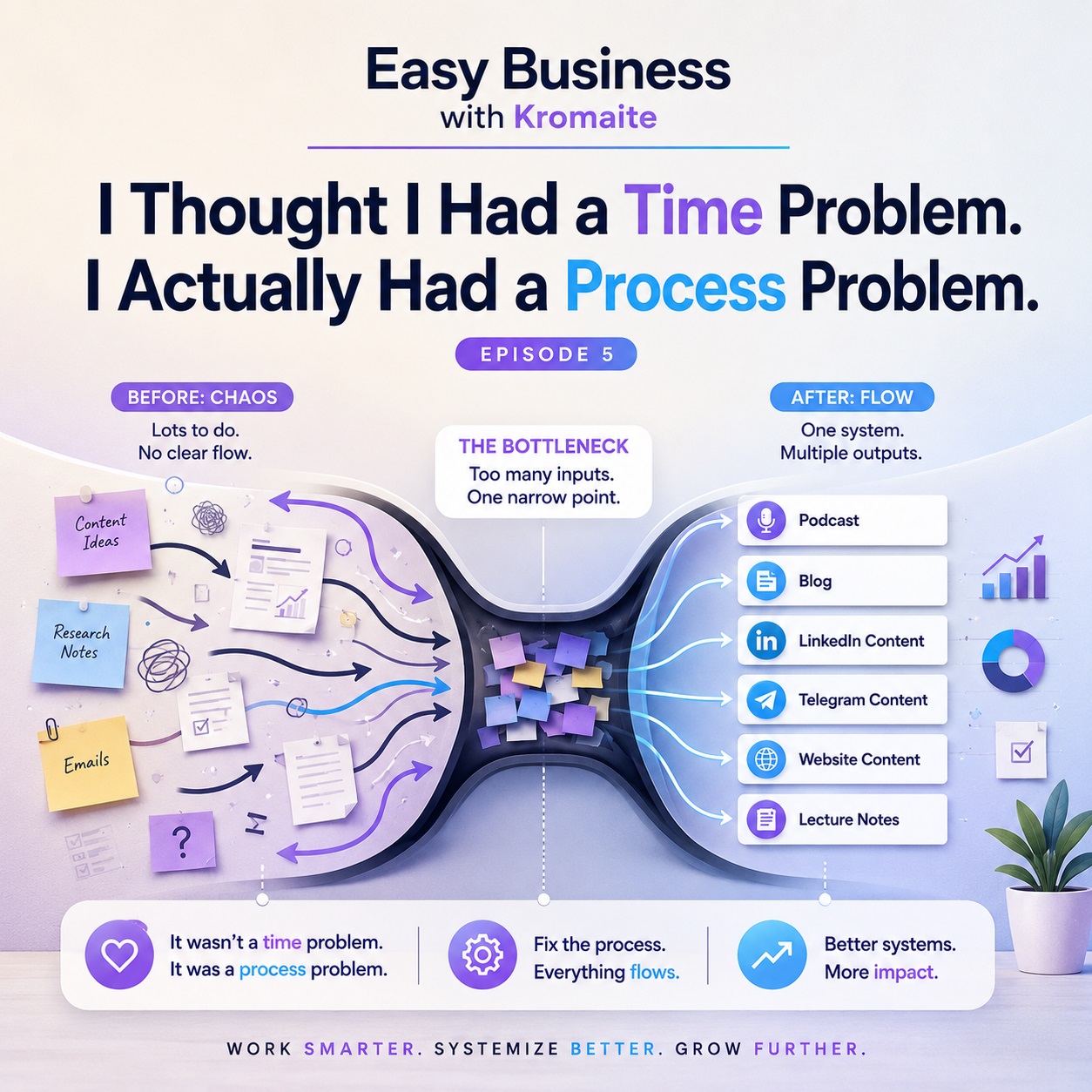
have a time problem. Sometimes
we have a process problem.
A few years ago I was spending 10 to 12 hours a week
creating content, writing posts,
planning content,
planning flows,
rewriting content.
turning one piece of content into
five different pieces of content.
And I thought
that was just part of running a business.
Then
I started changing my systems.
Not overnight, not perfectly,
one small change at a time.
And as a parent,
I can tell you that any system that gives me back even one extra hour
is immediately my favorite system.
So, fast forward to today. In the last couple of weeks, I've recorded three
episodes,
three podcast episodes,
and I'm working on this one, the fourth.
I've published blogs, I've created social media content,
and I've been working on my website,
been running my business. I still had time to be with my daughter,
which
If you're a parent, you know usually means answering
the same question 17
million times in a row
while trying to remember
what you were doing in the first place.
And I haven't had that kind of flexibility in years.
And it wasn't because I suddenly became more productive.
It wasn't because
I found more hours in the day.
It was because I stopped doing some things manually.
Today I want to share five places where AI
has genuinely saved
me time.
And for anyone worries
that I'm about to tell you to automate your entire business, don't worry.
Half of the fun of being a business owner is getting to make the decisions.
I'm talking about the repetitive task that make you wonder why you're doing the same thing 47th
time. Where AI has genuinely saved me time.
Not by replacing me,
not by doing my job
for me.
just helping me spend less time on repetitive work
so I can spend more time on the things
that actually need me.
And we'll also talk about where I still think humans should stay firmly
in charge.
So let's go.
Repetitive emails.
Let's start with something most business owners deal with:
emails.
Not the important ones, not the personal ones, the repetitive ones,
the
onboarding emails,
the frequently asked questions,
the emails explaining your process,
the follow-ups
you've written dozens of times before.
You've
probably rewritten the same e-mail over and over,
changing a few details each time.
AI is really good at helping with those.
You can create a template,
give AI basic information,
and let it create a first draft.
You still review it,
you still make sure it's accurate,
but you are not starting from a blank page every single time.
That's where the time savings happen.
Next,
reviewing information faster.
Now this one surprised me.
A while back I was invited to a business organization.
They sent me a PDF explaining how everything worked.
Now I could have just sat there and read every single page from beginning to end immediately.
Instead, I uploaded it to AI
and asked a simple question.
Are there any potential
red flags there?
Within seconds it highlighted several areas that deserved
a closer look.
Did AI make the decision for me?
No.
I still read part
of that document,
I still made the final decision,
and in the end I decided not to join.
What AI gave me wasn't an answer.
It gave me a starting point.
Instead of spending my time wondering
what I should
pay attention to,
I already had a short list of things worth investigating.
That's a very different use of
AI than people often talk about.
I wasn't asking it to think for me.
I was asking it to help me focus.
Research is another area where AI can be incredibly helpful.
And I want to be very clear about something.
AI is a great
place to start research.
It's not a replacement for research.
If I'm looking into a new topic, a new tool,
to try and understand something unfamiliar, AI can help me
get an overview quickly.
Instead of opening 12 tabs and trying to figure out where to begin, I can ask questions
and get general understanding of the topic.
Then I can decide what deserves deeper investigation.
The key is that AI gives me a starting point
not a final answer
the final answer
still requires judgment
verification
and sometimes good old-fashioned reading
now I have to be
honest with you notebookLM does wonders in that if you have research if you have papers
that
you trust that you know were written by someone who is
trustworthy,
you can upload them to NotebookLM
and you can get answers
from that PDF or text or whatever it is.
So there is, again,
you have to be,
you have to know your tools
and know which ones to trust and know which ones to
double check always. Like, NotebookLM still has that
little
disclaimer saying that this is
AI and you should always check,
but it has less hallucinations, as
we call them.
than others in the research department. when you upload the PDFs or text
to NotebookLM.
But most likely we're going to talk about it
in depth
a little bit later.
Not this episode, obviously,
but in future episodes because I'm completely in love with
NotebookLM at this point.
Next thing is repurposing content.
This is probably where AI saves me the most time.
So
let's take this podcast episode.
I don't just need a podcast.
I need also a blog post.
I need a LinkedIn post.
I need a Telegram post.
I need some website content, and sometimes I need graphics.
Years ago,
I would have created each piece separately.
Today I don't start from zero every single time.
I can use AI to help me
transform one piece of content
into multiple formats.
So for example, this episode will probably, not probably, this episode will become blog post,
a linkedIN post,
a telegram post,
and maybe even a part of a future lecture.
The core idea stays the same
the format
changes. The important part is that the original idea is still mine.
The examples are mine.
The opinions
are also mine.
The stories are mine.
AI simply helps me adapt that content for different places.
It's less about creating content and more about getting
more value from content I've already created.
Another which you don't really hear about a lot
is building an idea bank.
One of my favorite things
I've built recently
doesn't write content at all.
It collects ideas.
I have an AI agents running in the background
that help me discover interesting articles and different perspectives
on topics
I care about.
One focuses on finding useful information,
another focuses on finding alternative viewpoints.
Neither one writes my content,
neither one decides what I should think.
What they do
is help me build a growing library of ideas.
When it's time to create something, I'm not staring at the blank page wondering what to talk about.
I already have a collection
of interesting topics,
questions, trends,
and discussions
waiting for me.
Some become podcast episodes,
some become blog posts,
Some become things I talk about in the lectures.
Some become things I talk about in lectures.
The creativity is still mine.
The decisions are still mine. But the process of collecting information
happens automatically.
And that's
a huge time saver.
Now, where I don't hand things over to AI.
Now let's talk about the other side of this.
Because there are absolutely things I don't want
AI making decisions about.
Anything that represents me publicly gets reviewed by me.
Every blog post,
every social media post,
every podcast episode, everything.
Not because AI is bad at writing,
sometimes it's surprisingly good,
but because I want to make sure
the final version reflects what I actually think.
Sometimes I add an example, sometimes I remove something completely.
Sometimes I disagree with the draft and take it in a different direction.
And that's okay.
The goal isn't to remove yourself from the process,
The goal is to spend less time on repetitive work
so you can spend more time on the parts that genuinely need
your
experience, judgment and personality.
That's where
your value
lives.
And no tool can replace that.
But time savings aren't the only thing AI can offer.
I do lectures sometimes,
not just for business owners,
for older adults.
And when I first started talking about AI,
a lot of them were skeptical.
Some were curious,
some were nervous,
some were convinced it wasn't for them,
but I showed them how to use it.
Simple things,
how to ask questions, how to have a conversation,
Not only typing, but also talking because it can talk back.
How to get help understanding something?
And the next time I saw some of them, a few people told me
something I wasn't expecting.
They said
they felt less lonely.
And that stayed with me because AI isn't only about productivity.
It isn't only about business.
Sometimes
it's about having a tool that helps you learn something new,
explore an idea, ask a question
or simply have a conversation
when you need one.
That's a very different benefit
than saving 10 minutes. And honestly I think
it's just as important.
You just need to make sure you know the limits because it can't replace a human being,
right?
And if you have
problems, it can't replace a psychologist, for example,
a doctor.
But it can definitely
help. So let's do a quick recap.
Here's what covered today.
Five places where AI saves me time.
Repetitive emails,
review information faster,
research, repurposing content
and building an idea bank.
Notice that none of those involve replacing human judgment.
They are all
about reducing repetitive work.
That's where I think AI shines.
Not replacing people, helping people
and helping people stay focused
on the work
only they can do.
Also helping us spend less time on tasks you've already
done 50 times before.
And also helping us spend less time on tasks
we've already done 50 times before.
And giving us more time for the work that actually needs us.
Because at the end of the day that's the goal.
Not to work faster
not to automate everything,
but to make room for the things that matter most.
Thank you for spending part of your day with me,
and until next time,
stay smart, stay human,
and remember,
AI works for you,
not the other way around.
Bye for now.